
What to know
- Moisture problems can come from plumbing or roof leaks, water entering from outside, indoor humidity, condensation, or flooding.
- A water stain or damp surface is a symptom; finding and correcting the moisture source is more important than simply covering or cleaning the visible damage.
- EPA recommends drying wet or damp materials within 24–48 hours when possible to help prevent mold growth.
- Indoor relative humidity should generally be kept below 60%, with EPA identifying 30–50% as an ideal range when possible.
- Visible mold, extensive water damage, contaminated water, recurring moisture, hidden damage, or health concerns may require professional assessment or remediation.
Water inside a home is not always a plumbing leak.
It can enter through a roof or foundation, escape from pipes and appliances, condense on cold surfaces, accumulate because of high indoor humidity, or arrive suddenly during a flood.
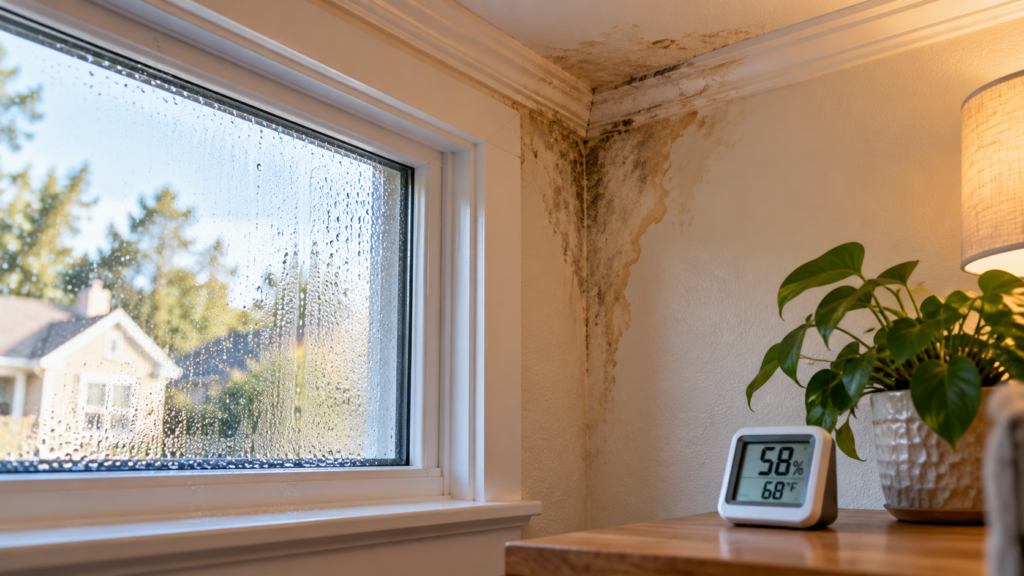
The visible symptom may be a stain on the ceiling, condensation on a window, peeling paint, a musty odor, damp insulation, or mold growth.
The important question is not simply “How do I remove this stain?”
It is:
“Where is the moisture coming from?”
Finding that answer is the first step toward deciding what needs to be dried, repaired, cleaned, monitored, or professionally assessed.
Why moisture matters in a home
Homes routinely contain water vapor.
Cooking, showering, breathing, washing dishes, drying clothes, and other normal activities add moisture to indoor air.
That does not automatically indicate a problem.
Problems begin when water or excessive moisture reaches places where it should not remain or when materials stay damp long enough to deteriorate.
Persistent moisture can damage drywall, insulation, wood, flooring, finishes, and other building materials. It can also create conditions that allow mold to grow.
The U.S. Environmental Protection Agency summarizes the principle simply: controlling moisture is the key to controlling indoor mold growth.
That makes moisture management a building problem first.
Where does unwanted moisture come from?
There is no single source.
For a homeowner, it is useful to divide moisture problems into several broad categories.
Plumbing leaks
Water may escape from:
- supply pipes;
- drain pipes;
- toilets;
- sinks;
- showers and tubs;
- water heaters;
- washing machines;
- dishwashers;
- refrigerators;
- HVAC condensate systems; and
- other water-using equipment.
Some plumbing failures are obvious.
Others can remain hidden behind walls, below floors, or inside cabinets.
Roof and exterior leaks
Rainwater can enter through damaged or poorly detailed parts of the building envelope.
Potential locations include roofs, flashing, roof penetrations, windows, doors, exterior walls, and other joints.
The location where a stain appears inside the house is not necessarily directly below the place where water entered.
Water can travel along framing or other surfaces before becoming visible.
Groundwater and foundation moisture
Basements and crawl spaces can be affected by water entering through or around the foundation.
Poor drainage around the house can contribute.
EPA recommends that the ground slope away from the foundation and identifies exterior water entry and basement seepage as potential indoor moisture sources.
Indoor humidity
A home can have a moisture problem without an active leak.
Everyday activities release water vapor into the indoor air.
If too much moisture accumulates or is not properly exhausted, indoor relative humidity can rise.
Bathrooms, kitchens, laundry areas, basements, and other moisture-producing or moisture-prone areas deserve particular attention.
Condensation
Condensation occurs when moist air encounters a sufficiently cold surface.
Common examples include:
- water on the inside of windows;
- damp cold-water pipes;
- moisture on cold exterior walls;
- condensation around HVAC equipment; and
- moisture on other cool building surfaces.
Condensation is therefore not necessarily evidence that rain or plumbing water is entering the home.
It may instead indicate a combination of humidity, surface temperature, insulation, ventilation, and air movement.
Flooding and major water events
Flooding is different from routine indoor humidity or a minor household leak.
Large amounts of water can affect walls, floors, insulation, furniture, electrical systems, HVAC components, and concealed building cavities.
Floodwater may also be contaminated.
Major flooding should therefore be treated as a potentially serious building and safety event rather than simply as a wet-floor problem.
What are common signs of a moisture problem?
Moisture can reveal itself in many ways.
Some signs are obvious. Others are indirect.
Look for:
- water stains on ceilings or walls;
- bubbling or peeling paint;
- swollen or damaged drywall;
- warped flooring;
- damp carpet;
- condensation on windows;
- rust or corrosion;
- damp or compressed insulation;
- musty odors;
- visible mold-like growth;
- recurring discoloration;
- water around plumbing fixtures or appliances;
- unusually damp basement or crawl-space areas; and
- persistent high indoor humidity.
One symptom does not necessarily identify the cause.
A water stain tells you that moisture has affected that location.
It does not tell you where the water originated.
What does a water stain on the ceiling mean?
A ceiling stain is evidence that moisture has reached the ceiling material.
Possible causes include:
- a roof leak;
- plumbing from a room above;
- a leaking bathroom fixture;
- HVAC or condensate problems;
- condensation; or
- a previous leak that has already been repaired.
The pattern alone may not provide a reliable diagnosis.
Before repainting the ceiling, determine whether the area is currently wet and investigate what is above or near the affected location.
Painting over a stain may improve its appearance, but it does not solve an active water problem.
Why are my windows wet inside?
Interior window condensation usually occurs when moisture in indoor air condenses on cold glass or framing.
A small amount under certain weather conditions does not automatically mean the window is leaking.
Persistent or heavy condensation, however, deserves attention.
It can indicate:
- high indoor humidity;
- cold interior surface temperatures;
- limited air circulation;
- insufficient ventilation; or
- a combination of these factors.
EPA recommends reducing indoor humidity, increasing ventilation or air movement where appropriate, and addressing cold surfaces to help reduce condensation.
What indoor humidity should you aim for?
Relative humidity changes with temperature and conditions, so there is no single number that describes every situation perfectly.
EPA recommends keeping indoor relative humidity below 60% when possible and identifies 30% to 50% as an ideal range.
A small digital hygrometer can provide a useful indication of indoor relative humidity.
One reading is not a complete diagnosis.
Measure over time and pay attention to rooms where moisture is produced or where condensation repeatedly occurs.
How can you reduce indoor humidity?
The correct approach depends on the source.
Common measures include:
- using bathroom exhaust fans while showering;
- using kitchen exhaust where appropriate;
- venting clothes dryers outdoors;
- repairing leaks;
- using air conditioning or dehumidification when needed;
- improving air circulation where appropriate; and
- avoiding unnecessary indoor moisture generation.
Exhaust systems should discharge where they are intended to discharge.
For example, exhausting moisture from a bathroom into an attic does not eliminate the moisture problem; it moves that moisture into another part of the building.
Moisture, condensation, and leaks are not the same thing
These terms are often used interchangeably, but they describe different mechanisms.
A leak involves liquid water escaping or entering where it should not.
High humidity means the air contains a relatively high amount of water vapor for its temperature.
Condensation occurs when that vapor turns into liquid water on a sufficiently cold surface.
A house can experience one, two, or all three.
Correctly identifying the mechanism matters because the solution changes with the cause.
A dehumidifier will not repair a leaking roof.
New roof shingles will not solve bathroom condensation caused by inadequate moisture exhaust.
Why does mold appear after moisture problems?
Mold spores exist naturally indoors and outdoors.
Trying to create a completely mold-spore-free home is not realistic.
The critical factor is moisture.
When spores reach a damp surface and conditions remain favorable, mold can grow.
That is why simply killing, wiping, or painting over visible mold without correcting the moisture source is not a durable solution.
If the moisture remains, the problem can return.
How quickly should wet materials be dried?
Time matters.
EPA recommends drying wet or damp materials and areas within 24 to 48 hours when possible to help prevent mold growth.
CDC similarly advises drying a home fully and quickly after flooding.
That does not mean mold will inevitably appear at exactly hour 49.
The 24–48-hour period should be understood as an action guideline: wet building materials should not simply be left to dry slowly while the source remains unresolved.
When a leak occurs:
- stop or control the water source if it is safe to do so;
- remove standing water where appropriate;
- begin drying affected materials;
- determine how far the water traveled; and
- monitor for continuing moisture.
Can wet drywall be saved?
Sometimes, but not always.
The answer depends on factors such as:
- how wet it became;
- how long it remained wet;
- whether it has lost structural integrity;
- whether mold has developed;
- what type of water caused the damage; and
- whether concealed materials behind it are also wet.
Porous materials are more difficult to clean when mold grows into them.
EPA notes that absorbent materials such as ceiling tiles and carpet may need to be discarded if they become moldy.
Do not assume that a surface is dry simply because it feels dry on the outside.
Can wet insulation be left in place?
Wet insulation deserves investigation.
Moisture can reduce performance, affect adjacent materials, and create conditions that should be corrected before additional insulation is installed.
The appropriate response depends on the insulation type, extent of wetting, source of the water, contamination, and whether the material can be completely dried.
Most importantly, do not add new insulation over an unresolved moisture problem.
Find and correct the source first.
Should you test mold before removing it?
Not necessarily.
If visible mold is present, identifying its exact species usually does not change the basic requirement to remove the mold and correct the moisture problem.
CDC states that if you see or smell mold, it should be removed and the moisture problem fixed; you do not need to know the type first.
The color of mold also does not reliably indicate how dangerous it is.
Testing may be appropriate in particular professional investigations, but homeowners should not assume that purchasing a mold test is always the necessary first step.
Can you clean mold yourself?
For small areas, sometimes.
EPA states that if the moldy area is less than about 10 square feet, roughly a 3-foot-by-3-foot area, homeowners can generally handle the cleanup themselves in many cases by following appropriate guidance.
That threshold should not be interpreted as permission to ignore other risks.
Professional assistance may be appropriate when:
- water damage is extensive;
- mold covers a larger area;
- contaminated water or sewage is involved;
- HVAC contamination is suspected;
- mold is hidden or repeatedly returns;
- the affected materials require substantial demolition;
- the source cannot be identified; or
- occupants have relevant health concerns.
People with certain respiratory conditions, allergies, immune suppression, or other vulnerabilities may need to avoid mold cleanup. CDC provides specific precautions for higher-risk individuals.
Should you use bleach on mold?
Do not assume bleach is automatically required.
EPA does not recommend biocides such as chlorine bleach as a routine practice for mold cleanup.
For hard surfaces, EPA guidance includes cleaning mold with detergent and water and drying the surface completely.
CDC provides additional guidance for situations where bleach is used and warns never to mix bleach with ammonia or other cleaners.
The larger point remains unchanged:
Cleaning the visible mold without solving the moisture source does not solve the underlying problem.
When is a moisture problem an emergency?
Some situations require faster action than routine condensation or a small stain.
Treat the situation more seriously when there is:
- active flooding;
- sewage or contaminated water;
- water near electrical equipment;
- a rapidly spreading ceiling bulge;
- structural damage;
- a major roof failure;
- extensive hidden wetting;
- significant mold contamination; or
- unsafe conditions following a storm or disaster.
Do not enter or work in an area where water, electricity, structural instability, contamination, or other hazards make it unsafe.
What about a bulging ceiling?
A ceiling that is visibly sagging or bulging after water exposure can indicate that water has accumulated above or within the ceiling assembly.
That can create a falling-material hazard.
Do not stand directly beneath a severely water-damaged or unstable ceiling.
The water source and the condition of the ceiling should be assessed safely.
How do you find the source of a moisture problem?
Start with the symptom, but investigate beyond it.
Step 1: Determine whether the area is currently wet
Fresh moisture suggests an active problem.
An old dry stain may indicate a previous event, but it still deserves investigation if the cause is unknown.
Step 2: Look above, behind, and nearby
Consider what is physically located around the affected area.
Is there:
- a bathroom above?
- plumbing nearby?
- a roof directly or indirectly above?
- HVAC equipment?
- an exterior wall?
- a window?
- a crawl space or basement below?
Step 3: Consider when the problem appears
Timing can provide clues.
Does it occur:
- during rain?
- after someone showers?
- when the air conditioner runs?
- during cold weather?
- during hot, humid weather?
- after using a particular appliance?
Patterns can narrow the investigation.
Step 4: Check indoor humidity
If condensation is widespread, measure relative humidity rather than guessing.
Step 5: Look for exterior water-management problems
Inspect accessible gutters, downspouts, drainage, roof conditions, windows, and the slope around the foundation where appropriate and safe.
Step 6: Investigate concealed moisture when necessary
If the visible symptom cannot be explained, moisture may be hidden within the building assembly.
At that point, professional investigation may be more appropriate than opening walls at random.
Should you buy a moisture meter?
A moisture meter can be useful, but it is not a diagnosis by itself.
Different materials and meter types can produce different readings.
A meter can help compare locations, identify potentially damp areas, and monitor drying, but the reading must be interpreted in context.
Likewise, a hygrometer measures relative humidity in the air, not the moisture content hidden inside a wall.
These tools answer different questions.
How can you prevent recurring moisture problems?
Prevention depends on controlling both liquid water and water vapor.
A practical home strategy includes:
- repairing plumbing leaks promptly;
- maintaining the roof and exterior envelope;
- managing roof drainage;
- directing water away from the foundation;
- using bathroom and kitchen exhaust correctly;
- venting dryers outdoors;
- maintaining HVAC condensate drainage;
- monitoring indoor humidity;
- reducing persistent condensation;
- addressing wet basements and crawl spaces; and
- investigating recurring stains or odors rather than repeatedly covering them.
The goal is not to eliminate water from normal life inside the home.
The goal is to keep water and moisture from accumulating where they can damage the building.
When should you call a professional?
Professional help becomes more valuable as uncertainty, scale, or risk increases.
Consider professional assessment when:
- you cannot identify the source;
- the problem repeatedly returns;
- water is entering through the building envelope;
- substantial plumbing repair is required;
- water damage extends into concealed cavities;
- mold growth is extensive;
- sewage or contaminated water is involved;
- HVAC contamination is suspected;
- structural materials appear damaged;
- electrical systems may have been exposed to water; or
- the work exceeds what you can safely inspect or repair.
The appropriate professional may be different depending on the problem.
A plumber, roofer, HVAC technician, building-envelope specialist, water-damage restoration contractor, mold remediation professional, or other qualified trade may be needed.
A practical way to approach moisture in your home
When you discover a water or moisture problem, avoid jumping directly to a cosmetic repair.
Use this sequence instead.
Step 1: Identify the symptom
Stain, standing water, condensation, damp material, odor, visible growth, or high humidity.
Step 2: Determine whether water is active
Is the area still getting wet?
Step 3: Find the likely source
Plumbing, roof, exterior water, groundwater, indoor humidity, condensation, HVAC, appliance, or flooding.
Step 4: Stop the source
Repair or control the cause where it is safe and appropriate to do so.
Step 5: Dry the affected area
Begin promptly. EPA recommends drying wet materials within 24–48 hours when possible.
Step 6: Assess the damage
Determine which materials can remain, which require cleaning or drying, and which may require replacement.
Step 7: Prevent recurrence
Do not consider the problem solved until the source has been corrected.
The bottom line
A moisture problem is not defined by the stain, odor, condensation, or mold you can see.
Those are clues.
The real problem is the source and pathway of the water.
A useful homeowner diagnosis therefore follows a simple sequence:
Find the moisture.
Understand where it came from.
Stop the source.
Dry the materials.
Assess the damage.
Prevent it from happening again.
That approach helps distinguish a small maintenance issue from a problem that requires a plumber, roofer, HVAC technician, restoration contractor, mold professional, or other specialist.
Sources and references
- U.S. Environmental Protection Agency — A Brief Guide to Mold, Moisture and Your Home
- U.S. Environmental Protection Agency — What Are the Main Ways to Control Moisture in Your Home?
- U.S. Environmental Protection Agency — How Do I Get Rid of Mold?
- U.S. Environmental Protection Agency — What Are the Basic Mold Cleanup Steps?
- Centers for Disease Control and Prevention — Mold
- Centers for Disease Control and Prevention — Mold Clean Up Guidelines and Recommendations
How we research
Habita2 prioritizes authoritative U.S. government agencies, technical standards and primary documentation. We translate that information into practical homeowner guidance and distinguish general information from situations that require qualified professional assessment.
Learn how Habita2 researches its guides →