What to know
- Your heating and cooling system is only one part of home comfort; insulation, air leakage, ductwork, humidity and thermostat settings also affect how the home feels.
- Rooms that are difficult to heat or cool do not automatically mean the HVAC equipment needs to be replaced.
- ENERGY STAR estimates that 20–30% of the air moving through a typical home's duct system can be lost through leaks, holes and poorly connected ducts.
- Regular HVAC maintenance can help prevent problems and keep heating and cooling equipment operating properly.
- Dirty filters can restrict airflow, but filter selection should also be compatible with the HVAC system rather than simply choosing the highest efficiency rating available.
Your heating and cooling equipment has a simple job: help keep your home comfortable.
But when one room is too hot, another is too cold, the energy bill suddenly increases, or the air conditioner seems to run constantly, it is easy to assume the HVAC equipment itself is the problem.
Sometimes it is.
Sometimes it is not.
Home comfort depends on a system that includes the heating and cooling equipment, thermostat, ductwork, airflow, insulation, air sealing, windows, humidity, climate, and the building itself.
Understanding how those pieces interact can help you determine what to check before paying for a repair or replacing expensive equipment.
What does HVAC mean?
HVAC stands for heating, ventilation, and air conditioning.
The term covers equipment and systems used to heat, cool, move, and in some cases ventilate or condition the air inside a building.
A home’s HVAC system may include:
- a furnace;
- central air conditioner;
- heat pump;
- boiler;
- ductwork;
- air handler;
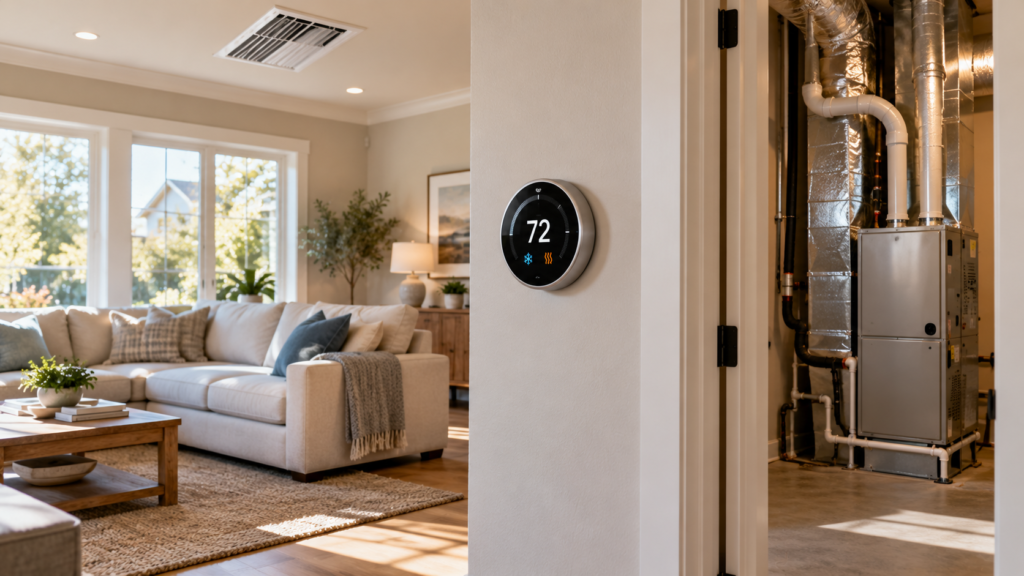
- thermostat;
- supply and return registers;
- filters;
- ventilation equipment; and
- related controls.
Not every home has all of these components.
Some homes use ductless heat pumps, boilers with radiators, electric resistance heating, window air conditioners, or combinations of different systems.
How does home heating work?
Heating systems add heat to the home or move heat into it.
The method depends on the equipment.
Furnaces
A furnace heats air and distributes it through ducts.
Depending on the system, the energy source may be natural gas, propane, oil, or electricity.
A blower moves the heated air through supply ducts and into rooms.
Return ducts bring air back toward the equipment so the cycle can continue.
Boilers
Boilers heat water rather than distributing heated air through conventional supply ducts.
The heated water or steam can provide heat through radiators, baseboards, or radiant systems.
Heat pumps
Heat pumps work differently.
Instead of producing heat primarily through combustion, a heat pump transfers heat.
During heating operation, an air-source heat pump extracts heat from outdoor air and transfers it into the home.
During cooling operation, the process reverses and moves heat from inside the home to the outdoors.
That ability to provide both heating and cooling makes heat pumps increasingly important in residential HVAC.
Electric resistance heating
Electric resistance systems convert electricity directly into heat.
Examples include electric baseboard heaters and some electric furnaces.
The appropriate heating system depends on climate, building characteristics, available energy sources, existing infrastructure, and other factors.
How does air conditioning cool a home?
An air conditioner does not simply “create cold air.”
It removes heat from indoor air and transfers that heat outside.
In a typical central air-conditioning system, refrigerant circulates through the system while indoor and outdoor components work together to move heat.
The indoor system also removes some moisture from the air during normal cooling operation.
The conditioned air is then distributed through the home.
If the system cannot move enough air, transfer heat effectively, drain condensate properly, or operate under appropriate controls, comfort and efficiency can suffer.
What does the thermostat actually do?
The thermostat tells the heating or cooling system when indoor conditions require it to operate.
It is the control point, not the equipment that actually heats or cools the home.
Thermostat problems can therefore sometimes resemble equipment problems.
Before assuming an HVAC unit has failed, check basic items such as:
- operating mode;
- temperature setting;
- schedule;
- batteries where applicable; and
- whether the thermostat appears to be reading the room temperature correctly.
A sophisticated thermostat cannot compensate for major problems elsewhere in the system.
Leaking ducts, inadequate insulation, incorrect equipment sizing, restricted airflow, or mechanical faults still need to be addressed.
Why is one room hotter or colder than another?
Uneven temperatures are among the most common home-comfort complaints.
Possible causes include:
- blocked supply registers;
- inadequate return airflow;
- duct leakage;
- damaged or disconnected ducts;
- crushed flexible ducts;
- poor duct design;
- air leakage through the building envelope;
- insufficient or uneven insulation;
- solar heat gain through windows;
- thermostat location;
- equipment problems; or
- differences in how rooms are used.
This is why replacing HVAC equipment solely because one bedroom is uncomfortable can be premature.
The room, distribution system, and building envelope should also be considered.
Why ductwork matters
In a forced-air system, the HVAC equipment can condition the air correctly and still fail to deliver it effectively.
The ducts are responsible for carrying that conditioned air through the house.
ENERGY STAR estimates that in a typical home, approximately 20% to 30% of the air moving through the duct system can be lost because of leaks, holes, and poorly connected ducts.
If conditioned air escapes into an attic, crawl space, garage, or other unconditioned area, the system may have to operate longer to maintain comfort.
Leaky return ducts can create additional problems by drawing unwanted air into the system.
Signs of possible duct problems include:
- rooms that are difficult to heat or cool;
- high heating and cooling bills;
- damaged or disconnected visible ducts;
- tangled or crushed flexible ducts; and
- ducts running through attics, crawl spaces, or garages.
Should HVAC ducts be insulated?
Ducts running through unconditioned spaces can gain or lose heat before conditioned air reaches the rooms.
ENERGY STAR recommends sealing accessible duct leaks and insulating ducts in unconditioned areas such as attics, crawl spaces, unfinished basements, and garages.
But insulation should not be used as a substitute for repairing disconnected or badly damaged ducts.
Seal and repair the distribution system appropriately first.
What does an HVAC filter do?
In a forced-air system, the filter helps capture particles from air passing through the system.
It also helps protect HVAC components from excessive dust and debris.
A heavily loaded filter can restrict airflow and contribute to poor system performance.
But there is another common misconception:
A higher filter rating is not automatically better for every HVAC system.
EPA recommends a filter rated at least MERV 13, or as high as the particular system can accommodate, when improved particle filtration is desired.
The important qualification is system compatibility.
A filter that creates excessive airflow resistance for equipment not designed to handle it can create problems.
If you are unsure what filter your system can accommodate, consult the equipment documentation or a qualified HVAC professional.
How often should you change an HVAC filter?
There is no universal replacement interval that works for every home and every filter.
EPA notes that manufacturers commonly recommend replacement around every 60 to 90 days, but actual conditions can require more frequent replacement.
Factors include:
- filter type;
- system runtime;
- pets;
- dust levels;
- renovations;
- wildfire smoke;
- indoor activities; and
- manufacturer instructions.
Inspecting the filter regularly is more useful than blindly assuming one calendar interval applies to every home.
Does HVAC control indoor air quality?
HVAC can influence indoor air quality, but it is not the entire solution.
EPA emphasizes that the most effective approaches to improving indoor air include reducing or removing pollutant sources and ventilating with clean outdoor air.
Filtration can supplement those measures.
A central HVAC filter only filters air while air is actually moving through the system.
It also cannot remove every type of indoor pollutant.
Indoor air quality should therefore not be reduced to simply buying a more expensive HVAC filter.
Why does HVAC affect humidity?
Air conditioning removes some moisture from indoor air as part of the cooling process.
Equipment operation, sizing, runtime, airflow, climate, and building conditions can all affect indoor humidity.
If cooling equipment operates improperly or the home has other moisture problems, indoor humidity can remain uncomfortable even when the thermostat shows an acceptable temperature.
Similarly, winter heating can contribute to very dry indoor conditions in some climates and homes.
If your house has persistent humidity problems, investigate the moisture source and HVAC operation rather than assuming the thermostat temperature tells the whole story.
Why does my air conditioner run constantly?
Long runtime does not automatically mean the air conditioner is failing.
Possible causes include:
- very hot outdoor conditions;
- thermostat settings;
- dirty filters;
- restricted airflow;
- duct leakage;
- inadequate insulation;
- significant air leakage;
- refrigerant or mechanical problems;
- dirty components;
- equipment sizing; or
- a home gaining heat faster than expected.
Some modern systems are also designed to operate for longer periods at lower output rather than repeatedly turning fully on and off.
The correct diagnosis depends on the system.
A sudden change from normal operation deserves more attention than runtime alone.
Why is the HVAC system turning on and off repeatedly?
Frequent short cycles can have several possible causes.
These may include thermostat problems, airflow restrictions, equipment sizing issues, control problems, or mechanical faults.
Repeated short cycling can reduce comfort and may place unnecessary stress on equipment.
Basic homeowner checks can include confirming thermostat settings and inspecting the filter.
Persistent short cycling should generally be evaluated by a qualified HVAC technician.
Why is airflow weak from the vents?
Weak airflow can result from problems at several points in the system.
Possible causes include:
- dirty filters;
- blocked registers;
- closed dampers;
- damaged ducts;
- disconnected ducts;
- crushed flexible ducts;
- blower problems;
- dirty HVAC components; or
- duct-system design issues.
Do not assume that weak airflow means you need a larger air conditioner or furnace.
Increasing equipment capacity does not repair a restricted or defective distribution system.
Why are my heating and cooling bills so high?
HVAC energy use depends on much more than the efficiency rating printed on the equipment.
High bills can be influenced by:
- weather;
- thermostat settings;
- energy prices;
- equipment efficiency;
- system maintenance;
- duct leakage;
- insulation;
- air leakage;
- windows;
- humidity;
- house size;
- occupancy; and
- personal comfort preferences.
Compare bills over equivalent periods when possible.
A higher bill during an unusually hot summer or cold winter does not necessarily indicate equipment failure.
A substantial unexplained change in energy consumption, however, can justify further investigation.
Does better insulation help HVAC performance?
Yes, because HVAC equipment and the building envelope interact.
Insulation slows heat flow through parts of the building.
Air sealing reduces uncontrolled air movement.
If a home loses conditioned air or gains outdoor heat rapidly, the HVAC system has to respond to that load.
ENERGY STAR specifically recommends addressing major air leaks and duct-system problems before investing in replacement heating and cooling equipment because those issues can sometimes be the real source of poor performance.
That is why Habita2 treats Insulation & Air Sealing and Heating & Cooling as related home systems rather than isolated topics.
Does closing vents save energy?
Closing registers in unused rooms may sound like an easy way to save energy, but forced-air systems are designed around particular airflow requirements.
Closing too many registers can alter pressure and airflow through the system.
Whether limited zoning or room-by-room control is appropriate depends on system design.
Do not treat closing large numbers of vents as a universal energy-saving strategy.
A properly designed zoning system is different from randomly closing registers throughout a conventional duct system.
What HVAC maintenance can homeowners do?
The appropriate DIY maintenance depends on the equipment.
Common homeowner tasks may include:
- inspecting and replacing filters as appropriate;
- keeping supply and return registers unobstructed;
- keeping outdoor equipment clear of leaves and debris;
- checking that condensate drainage appears normal;
- monitoring unusual noises or odors; and
- keeping the area around equipment accessible.
Do not remove safety panels, work on refrigerant circuits, modify combustion equipment, or perform electrical repairs unless you are properly qualified.
Does HVAC need professional maintenance every year?
ENERGY STAR recommends annual pre-season checkups, with cooling equipment checked in spring and heating equipment in fall.
A professional maintenance visit can involve more than changing a filter.
Depending on the system, technicians may inspect:
- thermostat operation;
- electrical connections;
- controls;
- condensate drainage;
- system operation;
- refrigerant performance;
- blower components;
- combustion equipment; and
- other manufacturer-specific items.
Maintenance cannot guarantee that equipment will never fail, but it can identify developing problems and help equipment operate as intended.
When should HVAC equipment be replaced?
Age alone does not determine whether equipment must be replaced.
ENERGY STAR suggests having equipment evaluated if it is more than about 10 years old or if it is no longer keeping the house comfortable.
But replacement should follow diagnosis.
Before spending thousands of dollars on new equipment, determine whether the underlying problem is actually:
- the HVAC unit;
- ductwork;
- insulation;
- air leakage;
- thermostat control;
- poor installation; or
- another building issue.
ENERGY STAR warns that improper HVAC installation can reduce system efficiency significantly, so purchasing high-efficiency equipment is not enough by itself.
Bigger HVAC equipment is not necessarily better
Heating and cooling equipment should be appropriately sized for the home.
Oversized equipment can create its own performance problems.
Undersized equipment may struggle to maintain comfort under design conditions.
Professional sizing considers factors such as:
- climate;
- floor area;
- insulation;
- windows;
- air leakage;
- orientation;
- occupancy;
- building construction; and
- internal heat gains.
Replacing equipment solely with the same nominal size as the old unit is not always the same as confirming that the size is appropriate.
When should you call an HVAC professional?
Professional service is appropriate when there are issues involving:
- refrigerant;
- combustion;
- gas;
- electrical components;
- internal mechanical failures;
- repeated breaker trips;
- persistent short cycling;
- frozen coils;
- significant condensate problems;
- unusual burning odors;
- carbon monoxide concerns;
- major duct-system defects; or
- equipment that cannot maintain reasonable comfort despite basic checks.
Turn equipment off and seek appropriate assistance if continued operation appears unsafe.
Fuel-burning equipment deserves particular caution because improper combustion or venting can create serious hazards.
What can you check before calling for service?
For a routine comfort problem, start with simple observations.
1. Check the thermostat
Confirm mode, temperature, schedule, and batteries where applicable.
2. Inspect the filter
A heavily loaded filter can restrict airflow.
3. Check accessible registers
Make sure supply and return openings are not unintentionally blocked.
4. Look at accessible ductwork
Obvious disconnections, crushed flexible ducts, or major damage can explain poor airflow.
5. Check the outdoor unit
Where applicable, look for obvious debris or obstruction around the equipment without opening or servicing the unit.
6. Look for water
Unexpected water around HVAC equipment or condensate systems deserves investigation.
7. Compare rooms
Determine whether the problem affects the whole house or one particular area.
That distinction can help separate an equipment problem from a distribution or building-envelope problem.
A practical way to approach heating and cooling problems
When your home is uncomfortable, avoid starting with the assumption that you need a new HVAC system.
Use a broader sequence.
Step 1: Define the symptom
Too hot, too cold, uneven rooms, weak airflow, excessive runtime, noise, humidity, or high energy use.
Step 2: Check the controls
Verify thermostat operation and settings.
Step 3: Check basic airflow
Inspect the filter and accessible registers.
Step 4: Consider distribution
Look for signs of duct leakage, damage, restriction, or poor room-to-room airflow.
Step 5: Consider the building
Insulation, air leakage, windows, solar exposure, and moisture can all affect comfort.
Step 6: Review maintenance
Determine when the equipment was last properly inspected or serviced.
Step 7: Escalate appropriately
If the problem involves mechanical, electrical, refrigerant, combustion, or persistent performance issues, use a qualified HVAC professional.
The bottom line
Your furnace, air conditioner, or heat pump does not operate independently from the house around it.
Home comfort is the result of a system.
The equipment conditions the air.
The ducts distribute it.
The thermostat controls operation.
The building envelope determines how quickly heat enters or leaves.
Humidity influences how the space feels.
Maintenance affects whether the equipment can perform as intended.
When something goes wrong, diagnose the system before replacing the most expensive component.
That is usually the better starting point for understanding what your home actually needs.
Sources and references
- ENERGY STAR — Heat & Cool Efficiently
- ENERGY STAR — Maintenance Checklist
- ENERGY STAR — Duct Sealing
- ENERGY STAR — When Is It Time to Replace?
- U.S. Department of Energy — Energy Saver: Tips on Saving Money and Energy in Your Home
- U.S. Environmental Protection Agency — Guide to Air Cleaners in the Home
How we research
Habita2 prioritizes authoritative U.S. government agencies, technical standards and primary documentation. We translate that information into practical homeowner guidance and distinguish general information from situations that require qualified professional assessment.
Learn how Habita2 researches its guides →