
What to know
- Window condensation forms when humid indoor air contacts a window surface cold enough for water vapor to condense.
- Condensation on the room-facing side of a window can indicate high indoor humidity, but window temperature, outdoor conditions and window performance also matter.
- EPA recommends keeping indoor relative humidity below 60%, ideally between 30% and 50%, although colder weather may require lower indoor humidity to limit window condensation.
- Bathroom and kitchen exhaust fans, properly vented clothes dryers and appropriate humidity control can help reduce excess indoor moisture.
- Persistent condensation should not be ignored because repeated wetting can damage surrounding materials and contribute to conditions that support mold growth.
- Condensation between panes of an insulated glass unit is different from normal interior-surface condensation and can indicate a problem with the sealed glazing unit.
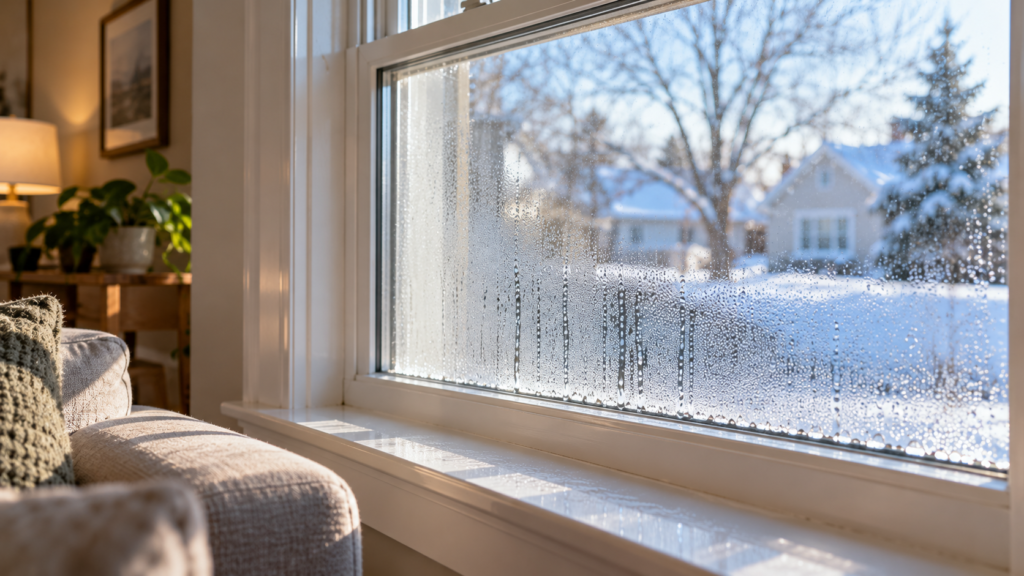
Condensation on the inside of a window can be as minor as a temporary patch of fog on a cold morning or as persistent as water running down the glass and collecting on the sill.
The basic process is straightforward: condensation forms when moisture in the air encounters a surface cold enough for that moisture to change from water vapor into liquid water.
But if your windows regularly become wet, the useful question is not simply why does condensation happen? It is why is enough moisture reaching a cold enough surface in your particular home?
Indoor humidity, outdoor temperature, ventilation, window performance, and everyday activities such as showering and cooking can all affect the answer.
Why Does Condensation Form on Windows?
Air contains water vapor.
The amount of moisture air can hold changes with temperature. When warm, humid indoor air reaches a sufficiently cold window surface, the air next to the glass cools. If the surface temperature falls below the dew point of that air, some of the water vapor becomes liquid water.
That is why window condensation is particularly common during cold weather.
The glass and other window components can be considerably colder than the indoor air, making the window one of the first visible places where an indoor moisture problem appears.
This does not automatically mean the window is leaking.
Water created by condensation comes from moisture already present in the air. Rainwater entering through a failed window assembly is a different problem and needs to be investigated differently.
Is Condensation on the Inside of Windows Normal?
A small amount of temporary condensation under certain conditions does not necessarily indicate a serious problem.
For example, you might see some condensation after:
- Taking a long shower
- Cooking or boiling water
- Running a dishwasher
- Drying clothes indoors
- Using a humidifier
- Experiencing unusually cold outdoor temperatures
What deserves more attention is frequent, heavy, or persistent condensation.
If water regularly covers the glass, runs onto the sill, wets trim or drywall, or appears in multiple rooms, it is worth investigating the home’s moisture level and the conditions around the affected windows.
Check Indoor Humidity First
A simple digital hygrometer can help you understand whether indoor humidity may be contributing to the problem.
The U.S. Environmental Protection Agency recommends keeping indoor relative humidity below 60 percent and ideally between 30 and 50 percent when possible.
That does not mean 50 percent is appropriate under every outdoor condition.
During cold weather, a home may need lower indoor humidity to prevent condensation because window surfaces become colder as outdoor temperatures fall.
If your windows are repeatedly wet, measure relative humidity in the affected rooms rather than relying only on how the air feels.
Where is the moisture coming from?
Normal household activities can release substantial moisture into indoor air.
Common sources include:
- Showers and baths
- Cooking and boiling water
- Dishwashing
- Clothes drying
- Humidifiers
- Unvented or improperly vented moisture-producing appliances
- Numerous occupants and everyday indoor activities
A tighter, more energy-efficient home can also retain indoor moisture more effectively than a very leaky house. That is generally beneficial for energy performance, but it makes controlled ventilation and moisture management more important.
Use Bathroom and Kitchen Ventilation
If condensation becomes worse after showering or cooking, ventilation is an obvious place to investigate.
Bathroom and kitchen exhaust fans should move moisture outdoors, not into an attic or another enclosed part of the house.
Use bathroom exhaust ventilation during showers and kitchen exhaust when cooking produces significant moisture.
ENERGY STAR also recommends allowing ventilation to continue after moisture-producing activities rather than switching it off immediately.
If a bathroom remains steamy for a long time or mirrors and windows stay wet well after a shower, the exhaust system may deserve closer attention.
Make Sure the Clothes Dryer Vents Outside
A clothes dryer produces a large amount of moisture.
Its exhaust should be vented to the outdoors rather than discharged into the house, attic, crawlspace, or another enclosed area.
If you notice increased condensation when laundry is being dried, check the dryer vent arrangement and make sure the duct is connected and functioning correctly.
Look at the Window Itself
Indoor humidity is only half of the condensation equation.
The other half is surface temperature.
A colder interior window surface reaches the dew point sooner than a warmer one. Window design, glazing, installation, air leakage, outdoor temperature, and airflow across the glass can all influence that surface temperature.
ENERGY STAR notes that energy-efficient windows are generally more resistant to condensation, but even efficient windows can experience condensation during cold weather.
That distinction matters because replacing a window is not automatically the first solution to window condensation.
If indoor humidity is excessive, a new window may reduce the problem without addressing the underlying moisture source.
Check Airflow Around the Window
Curtains, blinds, shades, furniture, and other objects can restrict warm indoor air from reaching the glass.
That can allow the interior window surface to remain colder.
ENERGY STAR recommends choosing window treatments that permit airflow over the window surface as part of reducing condensation risk.
If condensation occurs mainly behind tightly closed blinds or heavy curtains, compare conditions with the coverings open.
That simple observation can provide useful information before you assume the window itself has failed.
What If Condensation Is Between the Panes?
Moisture between panes of insulated glass is different from condensation on the room-facing surface.
Double- and triple-pane windows typically use a sealed insulated glass unit. If moisture or persistent fogging appears inside the space between panes, it may indicate that the glazing seal has failed.
You cannot normally wipe this moisture away from either side of the window because it is inside the insulated glass unit.
That situation is generally a window or glazing issue rather than an indoor humidity symptom alone.
A window professional or manufacturer can help determine whether the insulated glass unit can be replaced separately or whether another repair is appropriate.
What About Condensation on the Outside?
Condensation can also form on the exterior surface of a window.
That does not necessarily indicate a defect.
In warm, humid conditions, the exterior glass can sometimes become cool enough for outdoor moisture to condense on it. ENERGY STAR notes that exterior condensation can occur when the outside surface temperature falls below the dew point of humid outdoor air.
The location of the moisture therefore matters:
- Inside surface: investigate indoor humidity and window surface temperature.
- Between panes: investigate the insulated glass unit.
- Outside surface: may result from outdoor humidity and glass temperature.
Before diagnosing a window problem, determine exactly which surface is wet.
Why Persistent Condensation Matters
The water itself is only part of the concern.
Repeated condensation can keep window sills, trim, drywall, paint, or other nearby materials damp.
EPA emphasizes that moisture control is central to mold prevention. Persistent moisture can also contribute to staining, peeling finishes, deterioration of wood and other materials, and conditions favorable to biological growth.
If water is collecting on a window, dry the wet surface and investigate the moisture source rather than allowing the area to remain repeatedly wet.
What Should You Check?
If you regularly see condensation on the inside of your windows, work through the problem systematically.
1. Measure indoor relative humidity
Use a hygrometer in the affected room.
Compare the reading with conditions elsewhere in the house and observe whether humidity rises after showering, cooking, or other moisture-producing activities.
2. Identify when condensation appears
Ask:
- Only on very cold mornings?
- After showers?
- While cooking?
- In one room or throughout the house?
- Only behind closed blinds?
- Continuously throughout winter?
The pattern can help narrow down the cause.
3. Check exhaust ventilation
Confirm that bathroom and kitchen fans operate and actually vent outdoors.
4. Check the dryer vent
Make sure the clothes dryer exhaust is properly connected and terminates outdoors.
5. Review humidifier settings
If you use a humidifier, reduce its setting and observe whether the condensation decreases.
6. Improve airflow around the glass
Open blinds or curtains temporarily and see whether better air circulation changes the amount of condensation.
7. Determine where the moisture is located
Interior surface, exterior surface, and between-pane moisture point toward different explanations.
Should You Use a Dehumidifier?
A dehumidifier can help when indoor humidity is genuinely too high, particularly in humid conditions or spaces where moisture is difficult to control through ventilation alone.
But a dehumidifier should not become a substitute for correcting a specific moisture source.
If a bathroom fan does not vent properly, a dryer exhausts indoors, or water is entering through a building defect, address that underlying problem.
Use humidity measurements to determine whether dehumidification is actually needed rather than operating a dehumidifier solely because a window is wet.
Does Window Condensation Mean You Need New Windows?
Not necessarily.
Condensation alone is not enough to conclude that windows require replacement.
First determine:
- Indoor relative humidity
- Outdoor conditions
- Whether the condensation is inside, outside, or between panes
- Whether ventilation is adequate
- Whether airflow around the window is restricted
- Whether there are signs of air leakage or installation problems
Older or poorly performing windows can have colder interior surfaces and therefore be more susceptible to condensation. Better-performing windows can reduce that risk.
But moisture management and window performance are separate variables, and both should be considered before making an expensive replacement decision.
When Should You Investigate Further?
Consider a more detailed investigation when:
- Condensation is heavy or persistent.
- Water repeatedly collects on sills, walls, or trim.
- Paint is peeling or wood is deteriorating.
- You see or smell mold.
- Indoor humidity remains high despite reasonable ventilation.
- Only one window or one area develops unexplained moisture.
- Water appears during or after rain rather than primarily during cold weather.
- Moisture is trapped between panes.
- You suspect a hidden leak or another building problem.
Water appearing around a window is not always condensation. Exterior leaks, flashing problems, plumbing leaks, and other moisture sources can sometimes produce similar symptoms.
The Bottom Line
Window condensation is usually a moisture-plus-temperature problem.
Humid indoor air reaches a cold surface, the air cools below its dew point, and water appears on the glass.
For a homeowner, the most useful response is not simply wiping the window every morning. Determine how humid the home is, identify when and where the condensation occurs, check ventilation and moisture sources, and consider how cold the window surface becomes.
Occasional condensation under extreme conditions may be temporary.
Persistent condensation is information your home is giving you—and it is worth understanding why.
Sources and references
- U.S. Environmental Protection Agency — What are the main ways to control moisture in your home?
- U.S. Environmental Protection Agency — A Brief Guide to Mold, Moisture and Your Home
- U.S. Environmental Protection Agency — Interactive Mold House Tour
- ENERGY STAR — Residential Windows, Doors, & Skylights
- ENERGY STAR — Dehumidifiers
How we research
Habita2 prioritizes authoritative U.S. government agencies, technical standards and primary documentation. We translate that information into practical homeowner guidance and distinguish general information from situations that require qualified professional assessment.
Learn how Habita2 researches its guides →