
What to know
- An air conditioner can run without cooling effectively because of restricted airflow, thermostat settings, dirty components, duct problems, refrigerant issues or other equipment faults.
- A dirty air filter can restrict airflow and make the cooling system work harder while reducing its ability to cool the home effectively.
- Before assuming the AC has failed, homeowners can safely check thermostat settings, the air filter, supply vents and whether the outdoor unit is obstructed by debris.
- Dirty evaporator or condenser coils can reduce cooling performance and increase system runtime.
- Low refrigerant or a refrigerant leak requires professional diagnosis and service rather than a homeowner recharge.
- Rooms that remain too warm may also point to duct problems, inadequate insulation or air sealing rather than the cooling equipment alone.
When your air conditioner is running but the house still feels warm, it is easy to assume the system is broken.
Sometimes it is. But poor cooling can also come from much simpler problems, including an incorrect thermostat setting, a dirty air filter, restricted airflow, or debris around the outdoor unit.
Other causes—such as refrigerant problems, dirty coils, electrical faults, or damaged ductwork—usually require professional diagnosis.
The best approach is to start with the things you can safely check yourself and then recognize when the problem has moved beyond basic homeowner troubleshooting.
First, What Does “Running but Not Cooling” Mean?
Not every cooling complaint points to the same problem.
Your system might be:
- Running while blowing warm or room-temperature air
- Producing cool air but not enough of it
- Cooling some rooms but not others
- Running almost continuously without reaching the thermostat setting
- Starting and stopping but failing to make the home comfortable
Those symptoms can have different causes.
Before changing anything, notice what the system is actually doing. Check whether air is coming from the supply vents, whether that air feels cool, and whether the problem affects the entire home or only certain rooms.
1. Check the Thermostat
Start with the simplest possibility.
Make sure the thermostat is:
- Set to cooling mode
- Set below the current indoor temperature
- Operating normally
- Not displaying a low-battery warning if it uses batteries
Also check the fan setting.
A thermostat set to ON may run the indoor blower continuously, including when the compressor is not actively cooling. During those periods, air coming from the vents may not feel cold.
Using AUTO generally allows the blower to operate along with the system’s cooling cycle.
If the thermostat appears to be operating incorrectly or its temperature reading seems unrealistic, further diagnosis may be necessary.
2. Inspect the Air Filter
A dirty air filter is one of the easiest problems for a homeowner to check.
ENERGY STAR explains that a dirty filter slows airflow and forces heating and cooling equipment to work harder. Restricted airflow can also reduce the system’s ability to cool effectively.
Locate the system’s filter and inspect it according to the manufacturer’s instructions.
If it is dirty, replace or clean it as appropriate for your system.
ENERGY STAR recommends checking HVAC filters monthly, particularly during periods of heavy heating or cooling use, and changing them when dirty.
Do not automatically install a filter with a higher filtration rating than your HVAC system is designed to handle. The appropriate filter depends on the equipment and manufacturer’s specifications.
3. Check the Supply and Return Vents
Walk through the house and check the vents.
Make sure supply registers are open and not blocked by:
- Furniture
- Rugs
- Curtains
- Boxes
- Other household items
Return-air grilles also need adequate airflow.
If airflow seems weak throughout the house even after checking the filter and vents, the problem may involve the blower, coils, ducts, or another part of the system.
If only one or two rooms have poor airflow, the distribution system deserves particular attention.
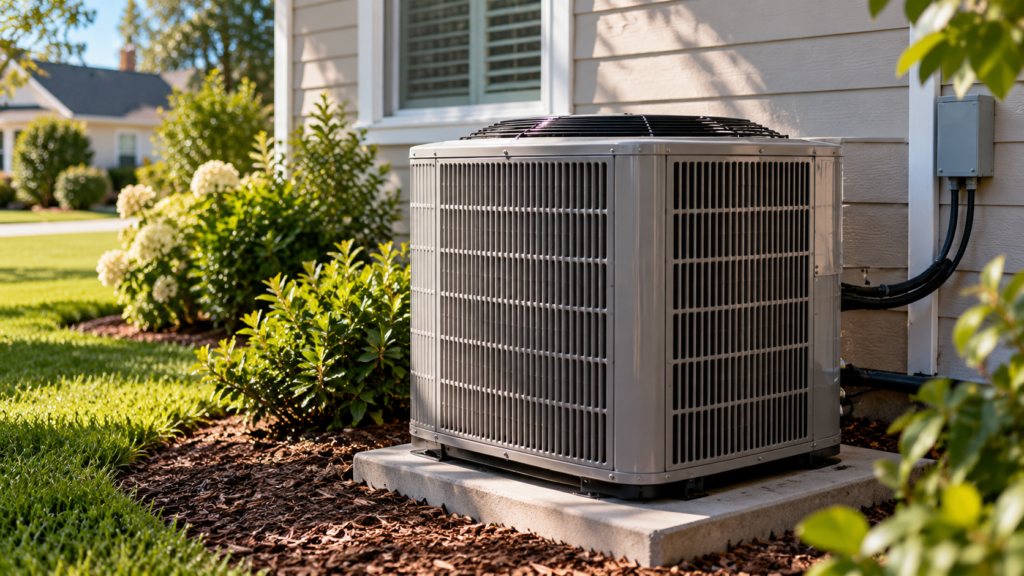
4. Look at the Outdoor Unit
For a typical split central air-conditioning system, heat collected inside the home is released through the outdoor unit.
Inspect the area around that unit without opening or disassembling it.
Look for obvious obstructions such as:
- Leaves
- Grass clippings
- Vegetation
- Dirt and debris
- Objects placed directly against the unit
ENERGY STAR recommends keeping indoor and outdoor HVAC units clean and clear of debris for proper performance.
Do not remove panels or reach into the equipment.
Cleaning internal components or investigating electrical problems is different from simply keeping the surrounding area unobstructed.
5. Dirty Coils Can Reduce Cooling
An air-conditioning system relies on heat transfer.
The evaporator coil absorbs heat indoors, while the condenser releases heat outdoors.
When those coils become dirty, heat transfer can become less effective.
ENERGY STAR notes that dirty air-conditioning coils can reduce the system’s ability to cool the home and cause it to run longer, increasing energy use and potentially reducing equipment life.
Coil inspection and cleaning may be part of professional HVAC maintenance.
Although keeping the area around the outdoor equipment clear is a reasonable homeowner task, avoid aggressive cleaning or disassembling equipment unless the manufacturer specifically provides a homeowner procedure.
6. The Problem Could Be Refrigerant
Refrigerant is essential to the cooling process.
If the system does not contain the correct amount of refrigerant, cooling performance can suffer.
The U.S. Department of Energy identifies low refrigerant or refrigerant leakage as a possible reason an air conditioner does not cool properly.
This is not a normal DIY troubleshooting step.
Do not simply attempt to add refrigerant.
A trained HVAC technician should determine whether the refrigerant charge is incorrect, whether a leak exists, and what repair is appropriate.
Adding refrigerant without addressing a leak does not correct the underlying problem.
7. Your Ductwork May Be Part of the Problem
If your AC appears to operate normally but certain rooms remain warm, the cooling equipment itself may not be the only issue.
Conditioned air must travel through the duct system before it reaches the rooms.
Problems can include:
- Leaky ducts
- Disconnected ducts
- Damaged ductwork
- Poorly insulated ducts
- Restricted airflow
- Distribution problems
DOE notes that duct problems can cause limited airflow, while ENERGY STAR identifies duct problems and inadequate insulation among possible explanations when some rooms are too hot or too cold.
This distinction is important.
A warm bedroom does not automatically mean you need a larger or newer air conditioner.
8. Insulation and Air Leakage Also Affect Cooling
Your HVAC system does not work independently from the rest of the house.
Heat can enter through the attic, walls, windows, doors, air leaks, and other parts of the building envelope.
If the home gains heat faster than the cooling system can remove it, the AC may run for long periods while comfort remains poor.
That means a cooling complaint can sometimes be partly a home-performance problem rather than purely an equipment problem.
This is particularly worth considering if:
- Upper floors become much hotter than lower floors
- Certain rooms are consistently uncomfortable
- The attic has inadequate insulation
- The home has substantial air leakage
- Cooling problems are concentrated around particular windows or exterior rooms
Before assuming that HVAC equipment needs replacement, consider the house as a complete system.
9. Extreme Outdoor Heat Changes the Situation
Air conditioners have finite capacity.
During unusually hot weather, the system may run for long periods and indoor temperatures may rise above the thermostat setting even when the equipment is operating.
That does not automatically establish that the equipment is defective.
However, a sudden change in performance—particularly if the system previously maintained comfortable temperatures under similar weather conditions—deserves investigation.
Look at the pattern rather than a single thermostat reading.
10. When Should You Call an HVAC Professional?
Basic homeowner checks have limits.
Consider professional service when:
- The system runs but the supply air is not cooling.
- Airflow remains weak after checking the filter and vents.
- The outdoor equipment is not operating normally.
- The system repeatedly trips a circuit breaker.
- You suspect frozen components.
- You see signs of a refrigerant problem.
- The system starts and stops abnormally.
- Cooling performance suddenly deteriorates.
- Some rooms remain persistently uncomfortable despite normal airflow.
- The equipment needs internal cleaning or electrical diagnosis.
- Basic checks do not identify the cause.
Refrigerant, electrical components, internal equipment, and many airflow problems require appropriate training and equipment to diagnose safely.
Should You Replace an AC That Is Not Cooling?
Not necessarily.
A cooling problem is not automatically a replacement decision.
ENERGY STAR recommends considering several factors when evaluating older equipment, including age, frequent repairs, increasing energy bills, uneven temperatures, humidity problems, and system noise.
An air conditioner or heat pump more than about 10 years old may justify discussing replacement when it also has performance or repair problems.
But age alone does not tell you why the house is uncomfortable.
Before replacing equipment, determine whether the actual problem involves:
- The equipment
- Maintenance
- Refrigerant
- Ductwork
- Installation
- Insulation
- Air leakage
- Controls
- Or a combination of these factors
Replacing equipment without identifying the cause can leave some comfort problems unresolved.
A Simple Troubleshooting Order
If your AC is running but your home is not cooling properly, work through the problem in this order:
1. Check the thermostat
Confirm cooling mode, temperature setting, and normal operation.
2. Check the air filter
Replace or clean it if needed according to the equipment manufacturer’s instructions.
3. Check the vents
Make sure supply and return airflow is not blocked.
4. Inspect around the outdoor unit
Remove obvious external obstructions without opening the equipment.
5. Compare rooms
Determine whether the problem affects the entire home or particular areas.
6. Consider the building itself
Insulation, air leakage, windows, and ductwork can all influence cooling performance.
7. Stop when professional diagnosis is required
Do not open electrical equipment, handle refrigerant, or attempt internal HVAC repairs without the appropriate training.
The Bottom Line
An air conditioner that runs without cooling effectively does not point to one single diagnosis.
Start with the simple things: thermostat settings, the air filter, vents, airflow, and obvious outdoor obstructions.
Then look at the pattern. Is the entire home warm, or only certain rooms? Is airflow weak? Did performance suddenly change? Does the system run continuously?
Those observations can help distinguish a basic maintenance issue from a problem involving coils, refrigerant, ductwork, equipment, or the home’s insulation and air sealing.
The goal is not to replace parts until the house feels cooler.
It is to identify why the cooling system and the home are not working together as expected.
Sources and references
- U.S. Department of Energy — Home Cooling 101
- ENERGY STAR — Maintenance Checklist
- ENERGY STAR — Heat & Cool Efficiently
- ENERGY STAR — Clean Heating and Cooling
- ENERGY STAR — When is it time to replace?
How we research
Habita2 prioritizes authoritative U.S. government agencies, technical standards and primary documentation. We translate that information into practical homeowner guidance and distinguish general information from situations that require qualified professional assessment.
Learn how Habita2 researches its guides →