
What to know
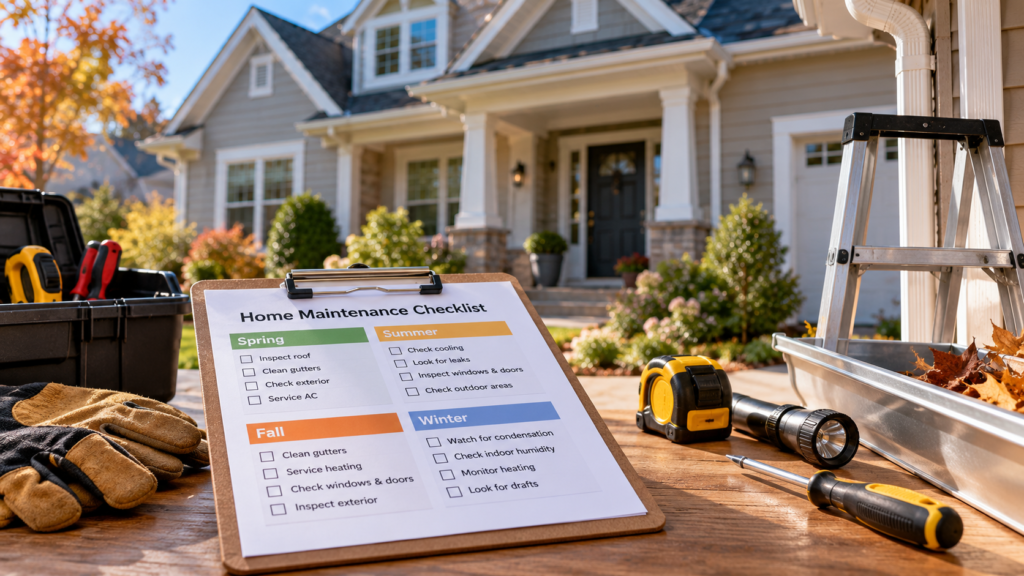
- Preventive home maintenance is easier to manage when tasks are divided into regular checks and seasonal inspections.
- Water deserves priority: roof drainage, plumbing leaks, condensation and other moisture problems should be investigated promptly.
- EPA recommends drying wet or damp materials within 24 to 48 hours after a leak or spill to help prevent mold growth.
- HVAC filters should be checked regularly, while professional heating and cooling maintenance is best scheduled before peak seasons.
- Gutters, downspouts and exterior drainage help move rainwater away from the home and should be kept functional.
- A maintenance checklist is a starting point, not a substitute for manufacturer instructions, local requirements or professional inspection when a problem exceeds normal homeowner maintenance.
Home maintenance is easier when you stop treating it as one enormous annual project.
Most homes need a combination of regular observation, seasonal maintenance, and occasional professional service.
The exact schedule depends on your climate, the age and construction of your home, the equipment you own, and manufacturer recommendations. A house in Minnesota does not face the same seasonal conditions as one in Florida or Arizona.
But the underlying priorities are remarkably consistent: keep water where it belongs, maintain heating and cooling equipment, protect the building envelope, and address small problems before they become larger ones.
Use this checklist as a practical starting point, then adapt it to your home.
Every Month or Two: Look for Changes
Some of the most useful maintenance does not require tools.
Walk through your home and pay attention to anything that has changed.
Look for:
- New water stains
- Musty odors
- Condensation
- Dripping fixtures
- Unusual HVAC sounds
- Weak airflow from vents
- Cracks or gaps that appear to be changing
- Doors or windows that no longer operate normally
- Peeling paint
- Damp areas
- Unexplained increases in indoor humidity
You do not need to diagnose every symptom immediately.
The objective is to notice changes early enough to investigate them.
Check Your HVAC Filter Regularly
Inspect the heating and cooling system’s air filter according to the equipment manufacturer’s instructions.
ENERGY STAR recommends checking filters monthly, particularly during periods of heavy heating or cooling use, and replacing them when they are dirty.
How often a filter actually needs replacement depends on factors such as:
- Filter type
- Equipment
- System runtime
- Pets
- Indoor conditions
- Manufacturer requirements
Do not automatically install the highest-rated filter you can find.
The filter needs to be compatible with your HVAC system and its airflow requirements.
Watch for Water and Moisture
Water problems deserve priority because a relatively small leak can affect drywall, insulation, flooring, framing, finishes, and indoor conditions.
Regularly look around:
- Sinks
- Toilets
- Showers and tubs
- Water heaters
- Washing machines
- Dishwashers
- Refrigerators with water connections
- Visible plumbing
- Ceilings below bathrooms
- Basements and crawlspaces
- Windows where condensation occurs
EPA recommends correcting water problems promptly and drying wet or damp materials within approximately 24 to 48 hours after leaks or spills to help prevent mold growth.
Do not simply dry a recurring wet spot.
Find out why it keeps getting wet.
Check Indoor Humidity
A basic digital hygrometer can help you identify excessive indoor humidity.
EPA recommends keeping indoor relative humidity below 60 percent and ideally between 30 and 50 percent when possible.
Conditions vary by climate and season, and colder weather may require lower indoor humidity to reduce condensation on cold surfaces.
Pay particular attention to:
- Persistent window condensation
- Damp basements
- Bathrooms that remain humid long after use
- Musty odors
- Moisture on pipes or walls
Humidity is information. Use it alongside what you can see and smell.
Spring: Inspect After Winter
Spring is a useful time to inspect how the home came through winter and prepare it for warmer, wetter conditions.
Check the roof from a safe location
You do not need to climb onto the roof to perform a basic observation.
From the ground or another safe location, look for obvious changes such as:
- Missing or displaced roofing material
- Visible damage
- Debris accumulation
- Sagging areas
- Damaged flashing that is visible from the ground
If something looks wrong, arrange a closer inspection by an appropriate professional rather than accessing an unsafe roof yourself.
Inspect gutters and downspouts
EPA specifically recommends cleaning and repairing roof gutters regularly.
Check whether gutters appear:
- Blocked
- Loose
- Damaged
- Overflowing during rain
Also inspect downspouts.
Water collected from the roof needs somewhere appropriate to go.
EPA recommends directing water away from the foundation and maintaining exterior drainage so water does not accumulate around the building.
Look around the foundation
After rain, walk around the exterior.
Look for areas where water:
- Ponds near the foundation
- Flows toward the house
- Collects around downspouts
- Remains unusually wet
EPA recommends that the ground slope away from the building so water does not enter or collect around the foundation.
Drainage problems are easier to understand when you observe the property during or shortly after rain.
Spring: Prepare the Cooling System
ENERGY STAR recommends professional pre-season HVAC maintenance and suggests scheduling cooling-system service in spring before contractors become busy during summer.
A professional cooling-system check may include inspection of:
- Thermostat settings
- Electrical connections
- Condensate drainage
- System controls
- Evaporator and condenser coils
- Refrigerant level
- Blower components
Homeowners can also keep the area around outdoor equipment clear of obvious debris and vegetation without opening or disassembling the unit.
If your air conditioner has a history of poor performance, do not wait for the hottest day of the year to investigate it.
Summer: Pay Attention to Cooling and Moisture
During hot weather, observe how the house actually performs.
Ask:
- Does the AC maintain a reasonably consistent temperature?
- Are some rooms significantly warmer than others?
- Is airflow noticeably weak?
- Is the system running much more than expected?
- Is indoor humidity unusually high?
- Is the condensate drain functioning normally?
Persistent comfort differences can involve more than the HVAC equipment.
Duct leakage, insulation, air leakage, solar heat gain, windows, and other building-envelope conditions can all contribute.
Summer: Check Exterior Sealants and Openings
Walk around the home and visually inspect accessible exterior areas around:
- Windows
- Exterior doors
- Utility penetrations
- Hose bibs
- Other wall penetrations
Look for obvious gaps, deterioration, or failed sealant.
Not every exterior joint should simply be filled with caulk. Building assemblies often include intentional drainage paths and different materials require appropriate products and installation methods.
When you are unsure how a joint is supposed to function, investigate before sealing it.
Fall: Prepare the Heating System
Fall is a logical time for heating-system maintenance.
ENERGY STAR recommends annual pre-season checkups, with heating systems checked before winter.
The appropriate service depends on whether your home uses a:
- Furnace
- Boiler
- Heat pump
- Other heating system
Follow manufacturer maintenance requirements and use a qualified professional for work involving combustion, refrigerant, electrical components, or internal equipment.
If your home uses fuel-burning equipment, maintenance also has a safety dimension—not merely an efficiency one.
Fall: Check Doors and Windows
As outdoor temperatures begin to drop, inspect windows and exterior doors for obvious air leakage.
Look at:
- Weatherstripping
- Door sweeps
- Stationary caulked joints
- Window operation
- Door alignment
- Visible gaps
A simple paper test can help identify weak seals around movable components.
Do not assume that a draft automatically means the window or door needs replacement. Weatherstripping, adjustment, or appropriate air sealing may solve localized problems.
Fall: Clean Gutters Again if Needed
Homes surrounded by deciduous trees may need another gutter check after leaves fall.
Blocked gutters can prevent roof runoff from draining as intended.
How often gutters require cleaning depends heavily on the house, roof configuration, nearby vegetation, and local conditions.
The important point is functional drainage—not following an arbitrary calendar.
Winter: Watch for Condensation
Cold weather can reveal moisture and air-leakage problems that are less obvious during other seasons.
Check for condensation on:
- Windows
- Exterior walls
- Pipes
- Other cold surfaces
A small amount of temporary window condensation under extreme conditions is different from persistent water accumulation.
If condensation is frequent or heavy, check indoor humidity, ventilation, and the temperature of affected surfaces.
Dry wet surfaces and investigate the underlying moisture source.
Winter: Notice Comfort Patterns
Winter is also a useful time to map comfort problems.
Pay attention to:
- Consistently cold rooms
- Drafts
- Cold floors
- Large temperature differences between levels
- Heating equipment that runs excessively
- Areas where snow melts unusually on the roof
These observations do not provide a diagnosis by themselves.
But they can help identify where a home energy assessment, insulation inspection, air-sealing work, or HVAC investigation may be useful.
Once a Year: Review the Whole Home
At least periodically, take a broader look rather than focusing only on individual maintenance tasks.
Review the condition of:
Roof and drainage
Look for visible damage, gutter problems, downspout issues, and water collecting near the foundation.
Exterior walls
Look for damaged finishes, open joints, deterioration, or evidence of water problems.
Windows and doors
Check operation, seals, visible damage, condensation patterns, and water intrusion.
Attic
If safely accessible, look for evidence of roof leaks, wet insulation, moisture, unusual staining, blocked ventilation, or other obvious changes.
Do not disturb suspected vermiculite insulation or materials that may contain hazardous substances.
Basement or crawlspace
Look for standing water, dampness, musty odors, plumbing leaks, or other evidence of moisture.
HVAC
Review filters, service history, unusual noise, airflow, comfort, and performance.
Plumbing
Look for active leaks, corrosion, staining, or moisture around accessible fixtures and connections.
Maintain Bathroom and Kitchen Ventilation
Exhaust ventilation helps remove moisture produced by everyday activities.
Check that bathroom and kitchen exhaust systems operate and vent as intended.
Bathroom exhaust should discharge outdoors rather than into an attic or other enclosed space.
Clothes dryers should also vent outdoors.
EPA identifies ventilation of bathrooms, dryers, and other moisture-generating sources as part of indoor moisture control.
If a room remains excessively humid after normal use, investigate why.
Do Not Ignore Small Leaks
A slow plumbing leak may not look urgent.
Neither may a small roof stain or occasional wet patch.
But building materials that remain damp can deteriorate and create conditions that support mold growth.
EPA’s guidance is straightforward: control moisture, correct leaks and water problems, and dry affected materials promptly.
A useful maintenance rule is:
Do not judge a water problem only by how much water you can see.
Location, duration, recurrence, and what is getting wet matter too.
Keep a Simple Home Maintenance Record
You do not need sophisticated software.
Keep a basic record of:
- HVAC service dates
- Filter changes
- Roof or gutter work
- Plumbing repairs
- Appliance maintenance
- Window and door repairs
- Water incidents
- Professional inspections
- Major equipment installation dates
Photographs can also be useful.
If a crack, stain, or area of deterioration changes over time, dated photographs make comparison easier than memory.
Maintenance records can also help when equipment needs service because you know what was previously repaired and when.
Know What Not to DIY
A home maintenance checklist should not encourage you to perform work that requires specialized knowledge or creates unnecessary risk.
Professional help is appropriate for tasks involving:
- Unsafe roof access
- Significant electrical work
- Gas or combustion equipment
- Refrigerant
- Structural concerns
- Significant water intrusion
- Extensive mold or contaminated water
- Hazardous materials
- Problems you cannot confidently identify or access safely
Routine observation is valuable precisely because it helps you recognize when a specialist is needed.
Your Checklist Should Fit Your Home
There is no universal maintenance calendar that applies perfectly to every U.S. home.
Climate matters.
So do:
- Construction type
- Roof design
- Foundation type
- Heating and cooling equipment
- Age
- Landscaping
- Trees
- Local weather
- Manufacturer requirements
A Florida homeowner may spend more time managing humidity and storm preparation.
A Minnesota homeowner may place greater emphasis on winter conditions and freeze protection.
A desert home presents different challenges again.
Use general maintenance guidance as a framework, then adapt it to the actual risks your house faces.
The Bottom Line
Good home maintenance is not about constantly repairing things.
It is about observing the house, controlling water, maintaining important systems, and responding when something changes.
Check filters and moisture regularly.
Use spring and fall to prepare heating and cooling equipment before peak seasons.
Keep roof drainage functioning.
Watch where rainwater goes.
Pay attention to condensation, leaks, drafts, unusual sounds, and changing comfort.
And when something gets wet, find the source rather than simply drying the visible symptom.
A checklist will not prevent every home repair.
But it can help you find many problems while they are still small enough to understand and manage.
Sources and references
- U.S. Environmental Protection Agency — A Brief Guide to Mold, Moisture and Your Home
- U.S. Environmental Protection Agency — Interactive Mold House Tour
- ENERGY STAR — Maintenance Checklist
- ENERGY STAR — Heat & Cool Efficiently
- U.S. Department of Energy — Home Energy Assessments
How we research
Habita2 prioritizes authoritative U.S. government agencies, technical standards and primary documentation. We translate that information into practical homeowner guidance and distinguish general information from situations that require qualified professional assessment.
Learn how Habita2 researches its guides →